
Cabinets
Inexpensive Custom Cabinets: Getting a Custom Look for Less
How to get inexpensive custom cabinets: stock vs semi-custom vs custom, where the money goes, and ways to make affordable custom kitchen cabinets.
By the Prime Construction team Updated October 13, 2026 5 min read
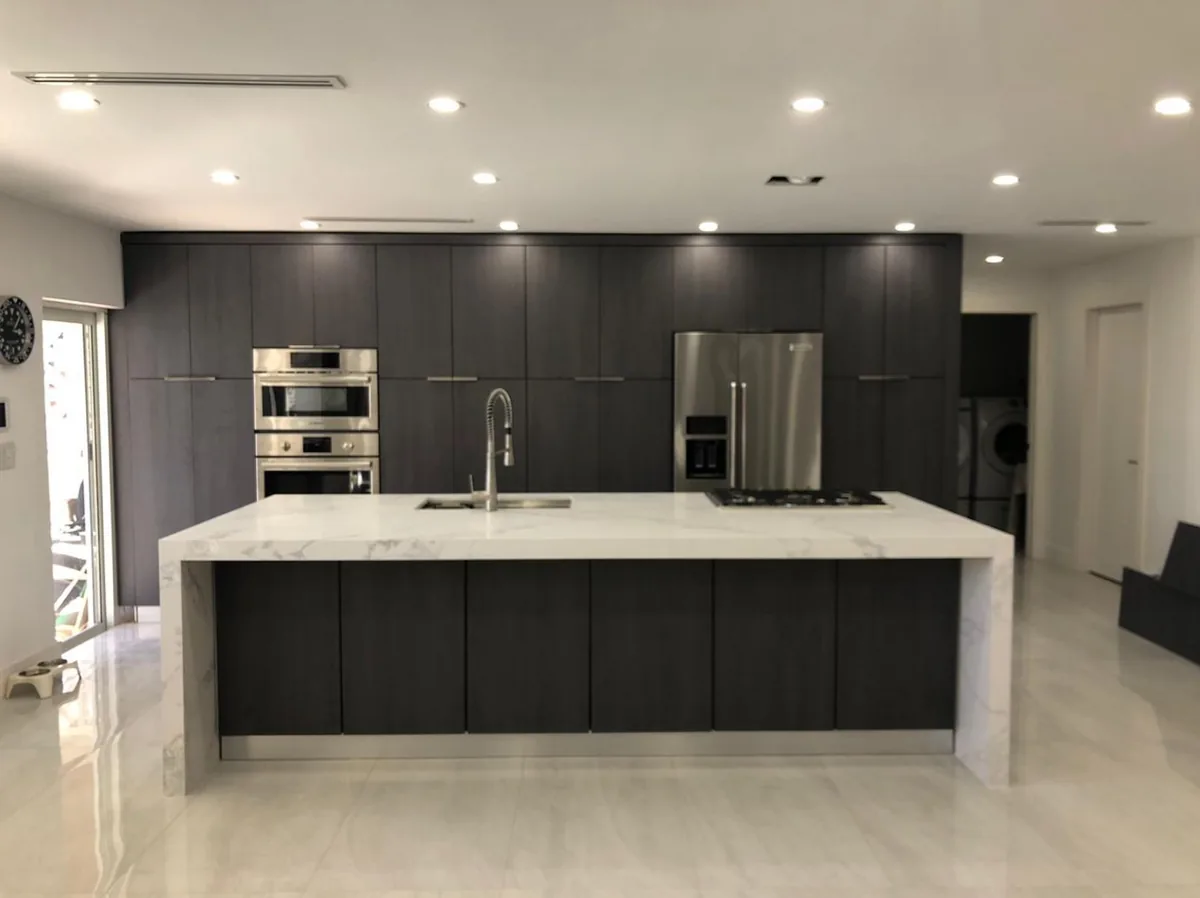
Inexpensive custom cabinets are possible when you spend custom money only where it matters, such as an odd-sized wall, a tall pantry or the island, and use standard sizes, simple doors and paint-grade materials everywhere else. For many kitchens, semi-custom cabinets give most of the custom look at a lower price, and refacing is the cheapest route when the existing boxes are sound. Below is how stock, semi-custom and custom compare, where cabinet money actually goes, and practical ways to keep affordable custom kitchen cabinets affordable.
Stock vs semi-custom vs custom cabinets
| Type | Sizes | Finishes and options | Lead time | Relative cost |
|---|---|---|---|---|
| Stock | Fixed widths in 3 in. steps | Limited door styles and colors | Shortest | Lowest |
| Semi-custom | Standard widths, with depth and height changes | Many doors, finishes and accessories | Moderate | Middle |
| Custom | Any size, built to the room | Any material, finish or detail | Longest | Highest |
Stock cabinets are a good fit when your kitchen has standard dimensions and you are happy with a common door and finish. Fillers close small gaps.
Semi-custom cabinets are where most remodels land. You can change depths (for example, shallower cabinets over a refrigerator or deeper ones beside it), add tall pantries and choose from a wide range of storage accessories.
Custom cabinets are built for your room. They make sense for odd wall lengths, sloped ceilings, furniture-style details, built-ins in other rooms, or when you want a specific wood species or finish.
For a broader overview of cabinet styles and sizes, see our kitchen cabinet design guide.
Where the money goes in custom cabinets
Knowing the cost drivers is the fastest way to cut cost without cutting quality.
- Linear feet and number of boxes. More cabinets, more cost. Every extra box adds material and labor.
- Door style. Flat slab and simple Shaker doors cost less than raised panel, inset or doors with applied moldings.
- Wood species and finish. Paint-grade wood and MDF panels are less expensive than stain-grade cherry or walnut. Multi-step glazes and distressing add labor.
- Inset construction. Doors set inside the frame need precise fitting and usually cost noticeably more than overlay doors.
- Accessories. Each roll-out, organizer, lift or specialty insert adds up. These are often where budgets creep.
- Decorative pieces. Crown molding, light rail, furniture feet, corbels, glass doors and end panels all add cost.
- Layout changes. Moving the sink or range adds plumbing and electrical work, and on slab homes, moving a sink typically costs $1,500 to $4,000 or more.
Cabinets are usually 30 to 40 percent of a full kitchen budget. As simple arithmetic, in a $35,000 to $75,000 mid-range Orlando remodel, that is roughly $10,500 to $30,000 for cabinets. That range is why cabinet choices move the total so much.
Ten ways to get affordable custom kitchen cabinets
1. Use custom only where you need it
Order standard or semi-custom boxes for the main runs, and use custom work for the one tricky wall, the island or a built-in pantry. This hybrid approach often gives a fully fitted look.
2. Keep the layout
Keeping the sink, range and refrigerator in place avoids plumbing, gas and electrical moves, which are some of the most expensive parts of a kitchen remodel.
3. Choose a simple door
A Shaker or slab door is timeless and costs less than raised panel or inset. It is also the most widely used style, so it rarely looks dated.
4. Go paint-grade
For painted cabinets, paint-grade hardwoods and MDF center panels are economical and paint well. MDF panels also move less with humidity than solid wood panels, which helps prevent cracks at the joints in Florida.
5. Pick affordable species for stain
If you want wood grain, oak, birch and maple are commonly less expensive than cherry or walnut. Oak and other open-grain woods also hide everyday wear well.
6. Spend on the boxes and drawers
Put money into plywood boxes, solid drawer boxes and full-extension soft-close slides. These are the parts you cannot easily upgrade later. Save on decorative extras instead.
7. Limit accessories to the ones you will use
Pick the three or four that matter most, such as a trash pull-out, deep pot drawers, a spice pull-out and a corner solution, rather than ordering every organizer offered.
8. Use open shelves in a few places
A short run of open shelving on one wall costs less than wall cabinets and breaks up the look. Keep it to items you use daily so dust does not build up.
9. Mix materials
Use a stained or painted island as the feature, with simpler perimeter cabinets. One focal point looks more designed than an expensive finish everywhere.
10. Consider refacing or new doors
If your boxes are solid, cabinet refacing gives you new doors, drawer fronts, veneer and hardware for a fraction of the cost of new cabinets. For an average Orlando-area kitchen, refacing typically runs $7,000 to $15,000 in 2026, usually 40 to 50 percent less than comparable new cabinets. Our cabinet refacing cost guide breaks it down.
What about RTA and used cabinets?
Ready-to-assemble (RTA) cabinets ship flat and are assembled on site. They can be an inexpensive option in standard sizes, but quality ranges from very good to poor. Check the box material, the drawer construction, the hinge type and how the pieces join. They will not solve an odd-sized wall the way a custom box does.
Used cabinets can work for a laundry room, garage or a kitchen where a found set happens to fit. See our guide to used kitchen cabinets in Orlando for how to inspect and measure them.
Quality checks that matter more than price
An inexpensive cabinet that fails at the sink base is not a bargain. Before you order, check:
- Box material. Plywood holds screws and resists moisture better than particleboard.
- Drawer boxes. Dovetail or doweled joints are stronger than staples.
- Slides and hinges. Full-extension soft-close slides and adjustable concealed hinges.
- Finish. A factory-applied finish usually outlasts a site-applied one, especially in humid kitchens.
- Formaldehyde compliance. Composite wood products sold in the US must meet federal formaldehyde emission standards. The EPA’s formaldehyde page explains the rule.
Timeline expectations
Kitchen design, selections and ordering typically take 3 to 8 weeks, and cabinet lead time is usually what drives it. Custom cabinets take longer than stock or semi-custom, so if you have a deadline, ask for lead times before you commit. On-site work for a full kitchen remodel typically runs 4 to 8 weeks.
Planning affordable cabinets in Orlando?
The cheapest path depends on what you have now: solid boxes may only need refacing, while a damaged or poorly laid out kitchen may be best served by semi-custom cabinets with a few custom pieces. Prime Construction measures your kitchen, builds a 3D design rendering and prices options side by side so you can choose. See our kitchen cabinets service, call (407) 404-3944 or request an estimate.