
Countertops
Quartz vs Granite Countertops: Cost, Pros and Cons (2026)
Quartz vs granite countertops compared for 2026: installed cost per sq ft, durability, heat, stains, sealing and which one fits an Orlando kitchen or bath.
By the Prime Construction team Updated October 13, 2026 6 min read
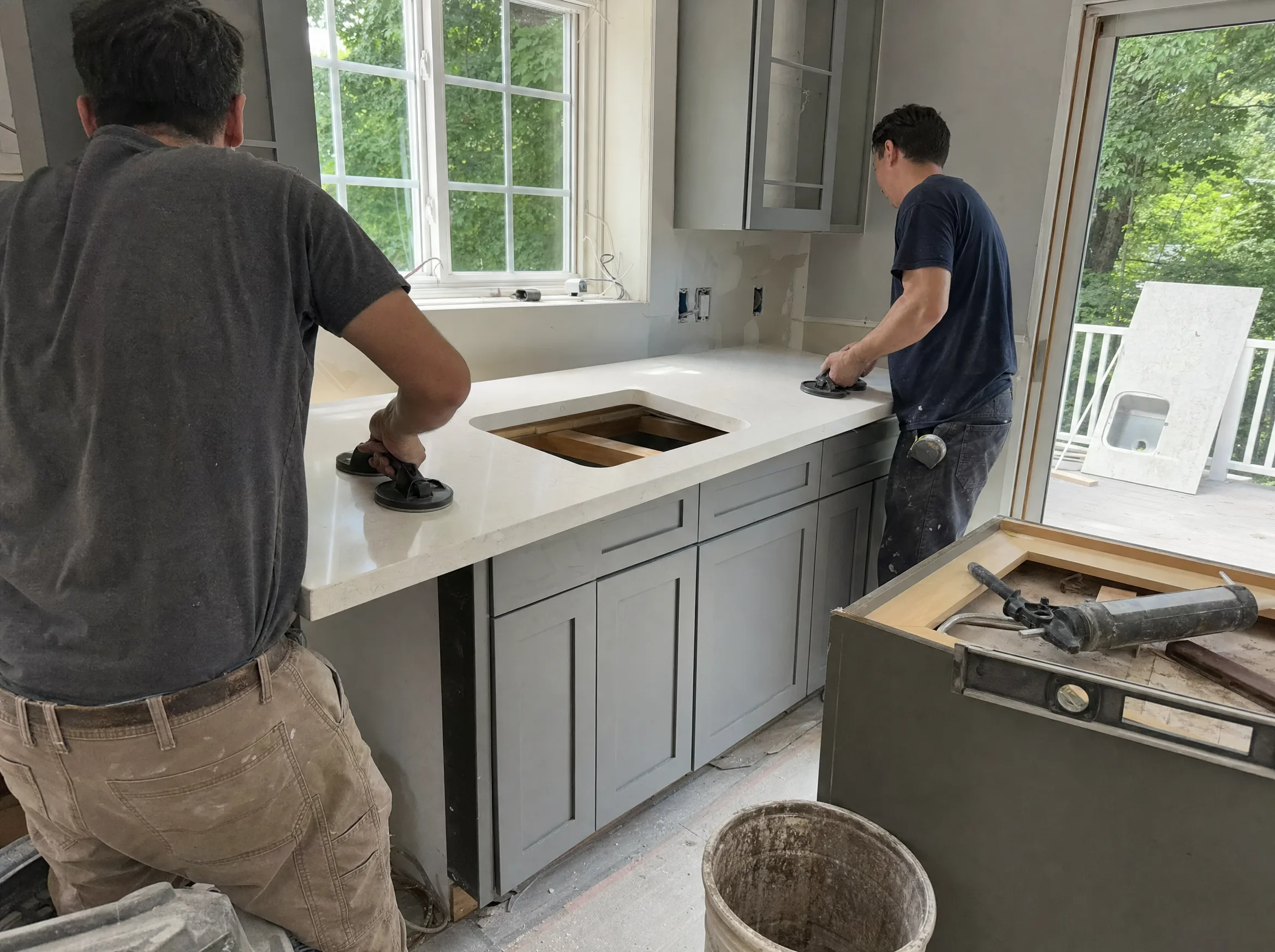
As of October 2026, the short answer on quartz vs granite countertops is this: quartz is the lower-maintenance choice (nonporous, never needs sealing, consistent color), while granite is natural stone with unique patterns and better heat tolerance that needs periodic sealing. Installed cost in the Orlando area overlaps heavily: granite typically runs $50 to $100 per sq ft and quartz $60 to $120 per sq ft. For most families who cook every day, the decision comes down to maintenance tolerance, heat habits and the look you want.
Quartz vs granite at a glance
| Factor | Quartz (engineered stone) | Granite (natural stone) |
|---|---|---|
| Installed cost (Orlando, 2026) | $60 to $120 per sq ft | $50 to $100 per sq ft |
| Typical 40 to 60 sq ft kitchen | About $3,000 to $7,000 | About $2,000 to $6,000 (by arithmetic) |
| Sealing | Never | Periodically, often every 1 to 2 years |
| Stain resistance | Very high, nonporous | Good when sealed |
| Heat resistance | Moderate, resins can scorch | High |
| Scratch resistance | High | High |
| Look | Uniform, wide color range, marble-look options | Every slab unique, natural movement |
| UV and outdoor use | Can fade or yellow in direct sun | Stable outdoors |
| Seams | Easier to match | Harder to hide on busy patterns |
These are planning ranges for installed tops (material, fabrication and installation). Edge profiles, sink cutouts, backsplash height, thickness and seams all move the final number, which is why a written estimate after templating is the only real price.
What quartz countertops are
Quartz countertops are engineered stone: crushed natural quartz mixed with resin binders and pigments, pressed into slabs and cured. Because the manufacturer controls the mix, the color and pattern are consistent from slab to slab, and the surface is nonporous.
Strengths:
- No sealing, ever.
- Excellent resistance to coffee, wine, oil and other common stains.
- Consistent look, which makes seams easier to match on long runs and islands.
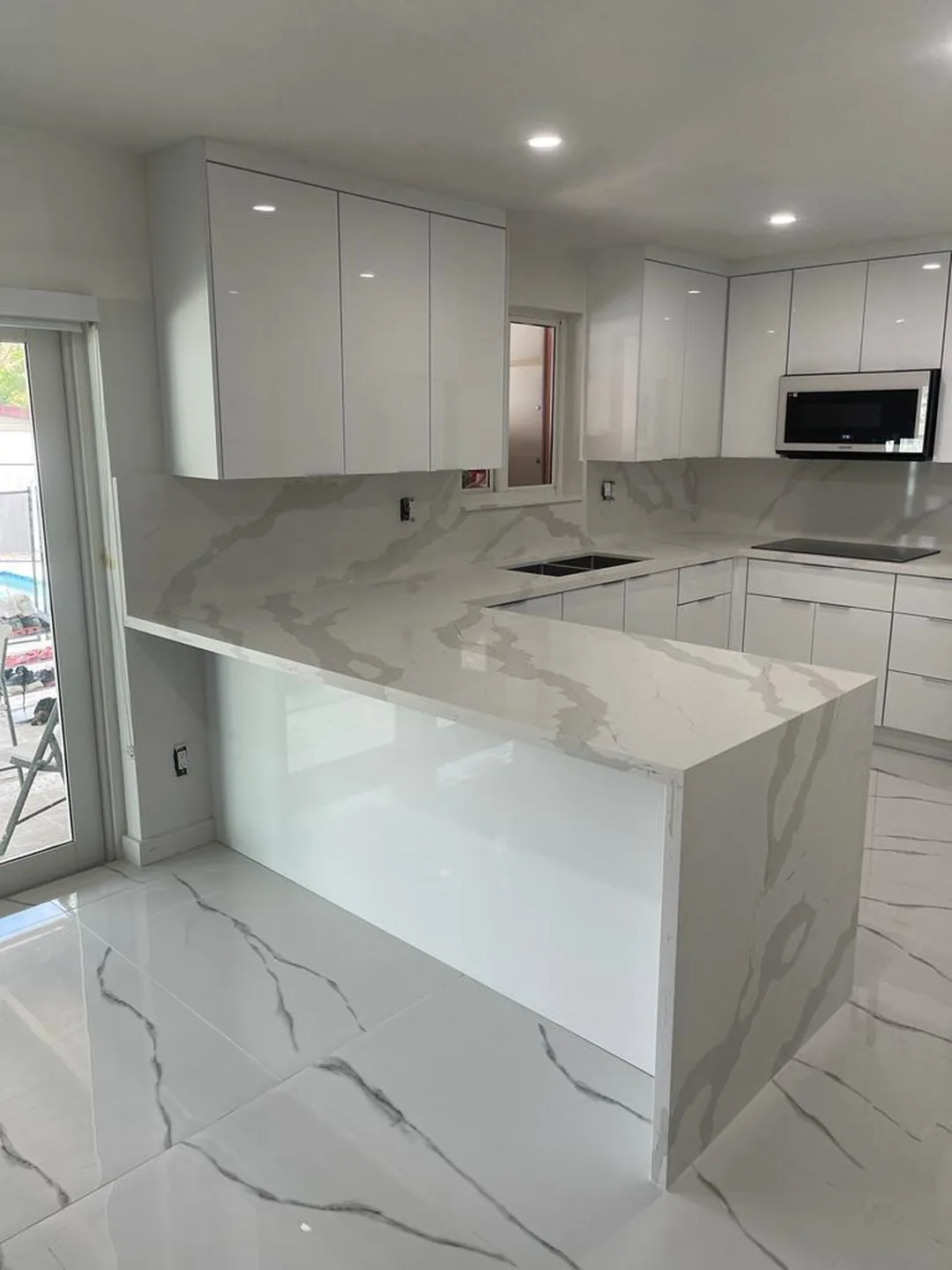
- Many styles that imitate marble without marble’s softness.
Weaknesses:
- Direct heat can scorch or discolor the resin.
- Strong sunlight over years can fade or yellow some colors, which matters near a large west-facing window or outdoors.
- Very large islands may need a seam, and premium designer patterns sit at the top of the price range.
For a deeper look at the material itself, see our guide to quartz stone.
What granite countertops are
Granite is natural igneous rock quarried in blocks, cut into slabs, then polished. No two slabs are the same, which is the main reason people choose it.
Strengths:
- Every slab is unique, with natural movement and depth.
- Handles heat better than quartz.
- Very hard and scratch resistant.
- Wide price spread, from common colors near the low end to exotic stones at the top.
Weaknesses:
- Porous to some degree, so it needs periodic sealing.
- Natural pits, fissures and color variation are part of the stone; some people love that and some do not.
- Seams are harder to hide on busy patterns.
- You should pick your actual slab in person, which takes a little more time.
Cost: quartz vs granite in Orlando
Most Orlando kitchens have 40 to 60 sq ft of countertop. Using the per-square-foot ranges:
- Granite: about $2,000 to $6,000 for a 40 to 60 sq ft kitchen.
- Quartz: about $3,000 to $7,000 for the same kitchen.
What pushes either material up:
- Grade and pattern. Common granite colors and basic quartz styles sit near the low end. Exotic granite and marble-look quartz with heavy veining sit near the top.
- Thickness. 3 cm slabs cost more than 2 cm, but often skip the built-up edge.
- Edges and cutouts. Mitered or ogee edges, undermount sink cutouts, cooktop cutouts and outlet cutouts all add fabrication time.
- Island size. An island larger than one slab means a seam or a jumbo slab.
- Full-height backsplash. Running the stone up the wall uses much more material than a 4 inch splash.
For context, here is how both compare with other popular materials, all installed per sq ft: laminate $25 to $50, butcher block $40 to $100, marble $75 to $200+, quartzite $80 to $200+. Quartzite is often confused with quartz, but it is a natural stone (metamorphosed sandstone) that is usually harder than granite and needs sealing like granite.
Which is better for an Orlando kitchen?
Central Florida conditions do not favor one material inside the house. Indoors, both handle our humidity well. A few local points are worth knowing:
- Outdoor kitchens and lanais. Strong sun and heat favor granite. Many quartz products are not rated for outdoor use because UV can fade them.
- Big west-facing windows. If a section of countertop sits in direct afternoon sun, ask about UV stability before choosing a quartz color.
- Rentals and vacation homes. Around Kissimmee and Davenport, where many homes are short-term rentals, the no-sealing benefit of quartz makes it a common choice because guests do not baby the counters.
Decision guide: choose quartz if, choose granite if
Choose quartz if:
- You want zero maintenance and do not want to think about sealing.
- You want a consistent color, a solid white, or a marble look.
- You have kids, a busy kitchen or a rental, and stains are your biggest worry.
Choose granite if:
- You want natural stone and a slab nobody else has.
- You set hot pans down without thinking (though a trivet is still smart).
- The top is outdoors or in strong sun.
- You found a common color that lands at the low end of the range.
Either works if: you want a durable, premium-looking surface that adds appeal over laminate.
Care and cleaning
- Quartz: warm water and mild dish soap. Avoid harsh abrasives, oven cleaner and high-pH degreasers. Use trivets for hot pans.
- Granite: pH-neutral stone cleaner or mild soap. Wipe acidic spills like lemon juice and wine promptly. Reseal when water starts to darken the stone.
- Both: use a cutting board. Neither material is hurt much by a knife, but both will dull your knives.
A note on worker safety during fabrication
Cutting, grinding and polishing stone releases respirable crystalline silica dust, and engineered quartz tends to contain a high share of silica. Breathing that dust is a recognized health hazard for fabrication workers. The U.S. Occupational Safety and Health Administration has a respirable crystalline silica standard that sets exposure limits and requires controls such as wet cutting and ventilation. This is a shop safety issue, not a hazard from the finished, installed countertop in your home, but it is reasonable to ask any fabricator how they control dust.
Bathrooms: quartz vs granite vanity tops
The same trade-offs apply on a vanity, with lower stakes because the area is small. Quartz is popular for vanities because makeup, toothpaste and hair products do not stain it. A remnant piece of either material can make a single vanity top inexpensive. See our quartz bathroom countertops guide for vanity-specific tips.
Planning new countertops in Orlando?
Countertops are often part of a larger update, and the right choice depends on your cabinets, sink, lighting and how you cook. Prime Construction measures your kitchen, helps you compare samples and slabs, and gives a written estimate. Learn more about our countertop installation or our full kitchen remodeling process, call (407) 404-3944, or request an estimate.