
Countertops
Quartz Stone Vanity Top: Pros, Cons, Sizes and Cost
Is a quartz stone vanity top right for your bathroom? Pros and cons, quartz vs marble and granite, thickness, sizes, sinks, edges and Orlando costs.
By the Prime Construction team Updated October 13, 2026 6 min read
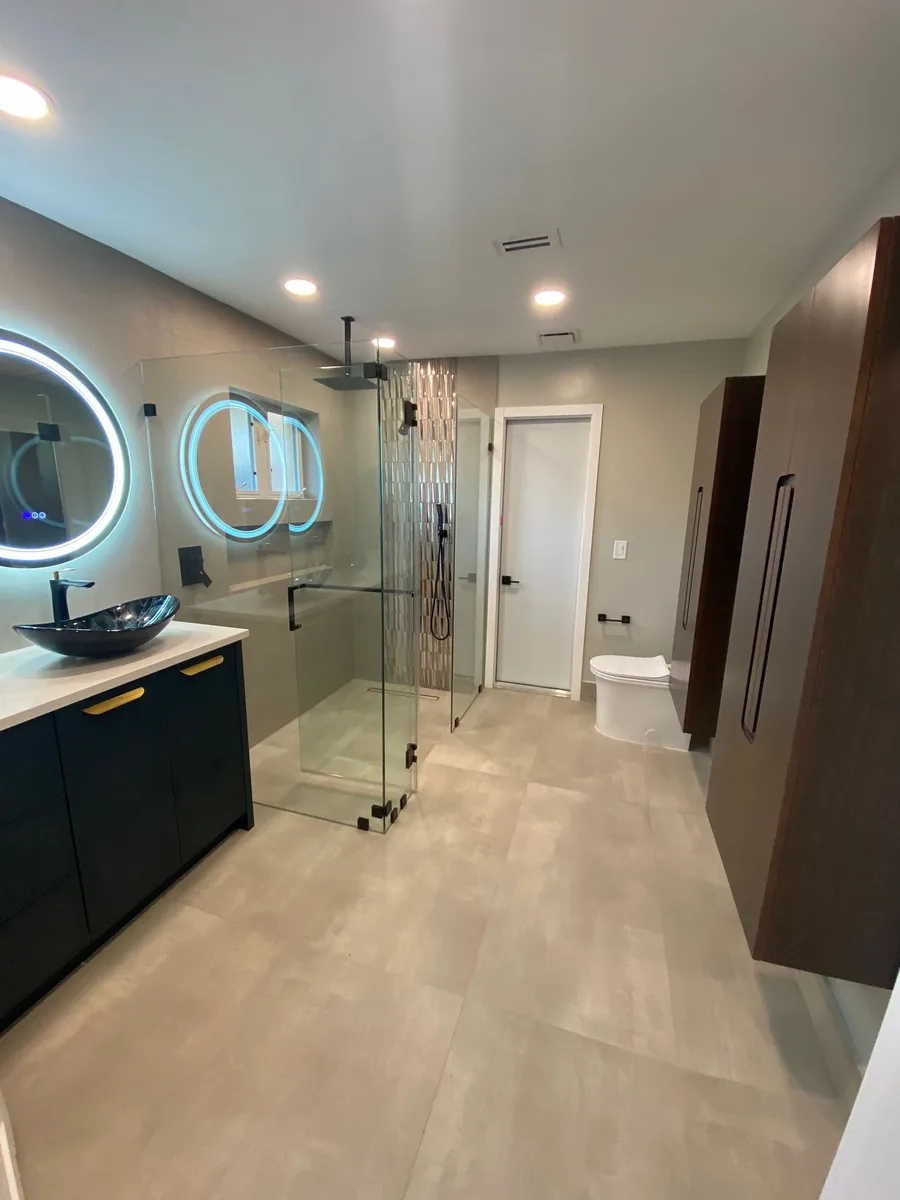
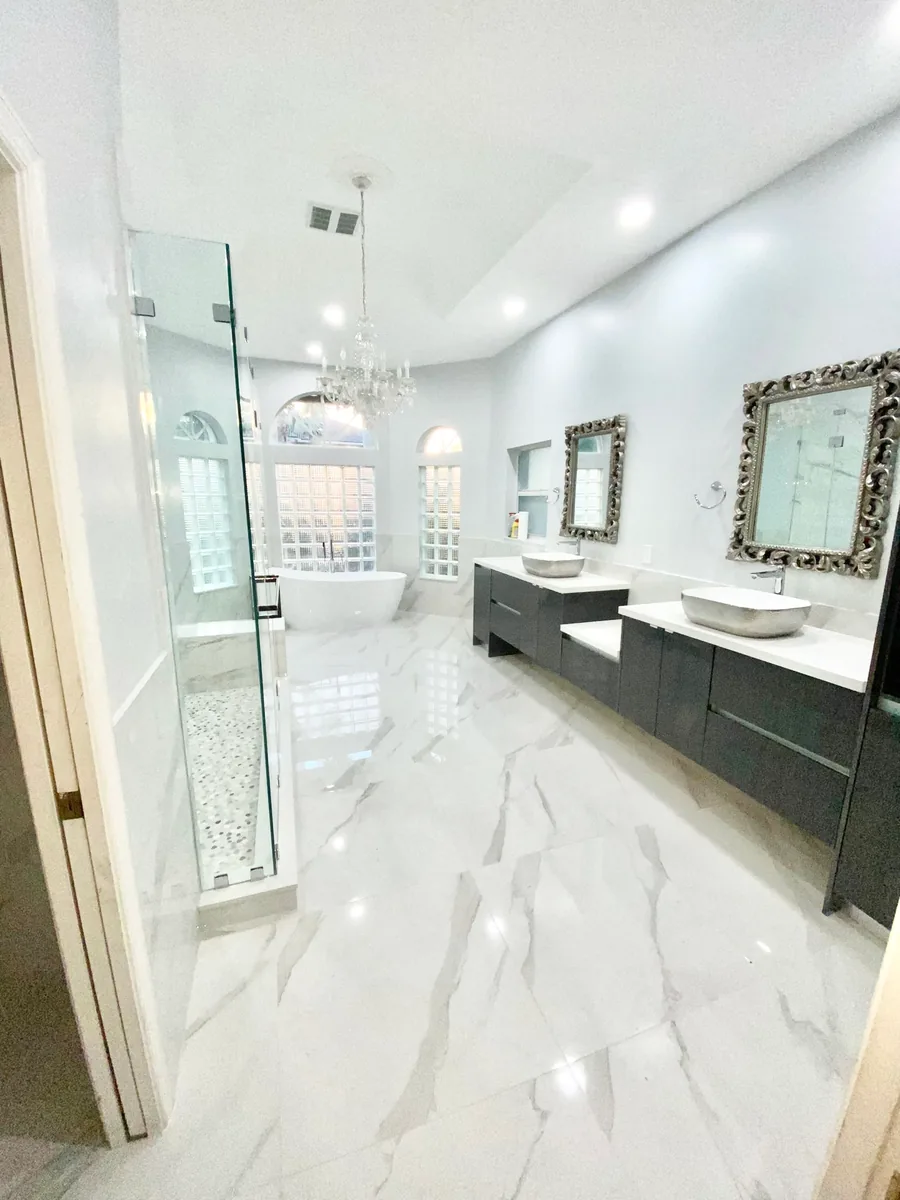
A quartz stone vanity top is one of the most practical choices for a bathroom: it is non-porous, so it resists stains from makeup and toothpaste, it never needs sealing, and it comes in solid colors and marble-look patterns. The trade-offs are cost (more than cultured marble, often similar to granite) and heat, since the resin in quartz can scorch under a hot styling tool. Below we compare quartz with the other vanity top materials and cover thickness, sizes, sinks, edges and what it costs in Orlando.
What a quartz vanity top actually is
Quartz countertops are engineered stone. Ground natural quartz is mixed with polymer resin and pigments, pressed into slabs and cured. The quartz content gives hardness and the resin binds it and seals the surface.
That process explains its main traits:
- Non-porous. Liquids do not soak in, so it does not need sealing and resists stains.
- Consistent. Color and pattern are uniform from slab to slab, which helps when a vanity top has to match a shower bench or a tub deck.
- Hard and scratch resistant in normal use.
- Sensitive to heat and strong chemicals because of the resin.
Do not confuse quartz with quartzite, which is a natural stone that is quarried, porous and needs sealing. For a deeper look at the material itself, see our quartz stone guide.
Pros and cons of a quartz stone vanity top
Pros
- No sealing, ever
- Resists stains from cosmetics, hair dye and toothpaste better than natural stone
- Easy daily cleaning with mild soap and water
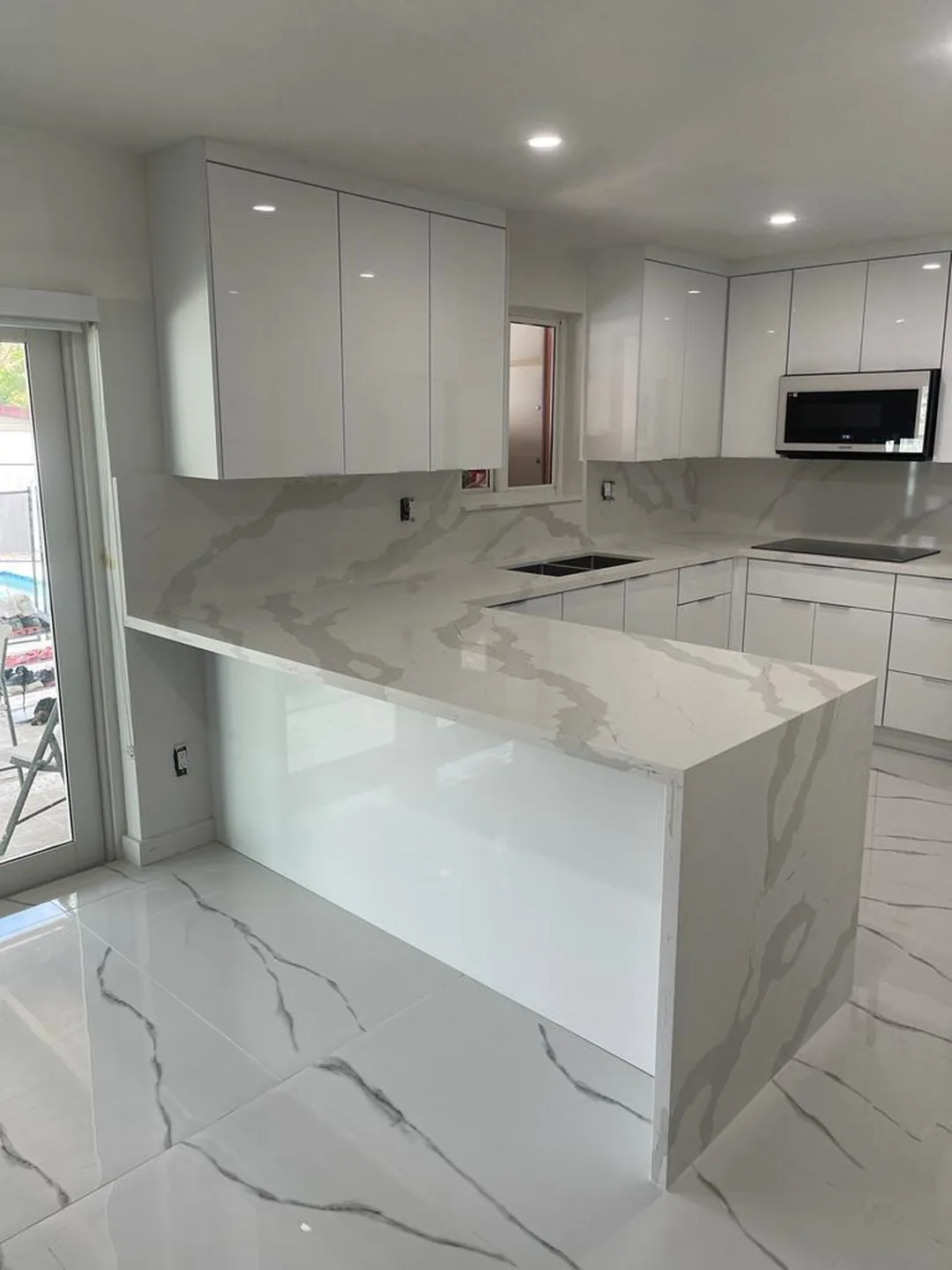
- Wide range of colors, including marble-look and concrete-look designs
- Works with undermount, vessel and drop-in sinks
Cons
- Costs more than cultured marble or laminate
- Hot styling tools set directly on it can scorch the resin
- Some colors can fade or yellow in strong direct sunlight, which is rarely an issue in a bathroom but matters near a big window
- Strong chemicals like oven cleaner, paint stripper and some drain cleaners can damage the surface
- Seams are visible on long tops, though most vanities are short enough for one piece
Quartz vs other vanity top materials
| Material | Sealing | Stain resistance | Heat | Look | Relative cost |
|---|---|---|---|---|---|
| Quartz | None | High | Avoid hot tools | Uniform, many colors and marble looks | Mid to high |
| Granite | Periodic | Good when sealed | Good | Natural, speckled or veined | Mid to high |
| Marble | Regular | Low, also etches | Good | Classic veining | High |
| Cultured marble | None (gel coat) | Good | Avoid hot tools | Integrated sink, glossy | Low |
| Solid surface | None | Good, repairable | Avoid hot tools | Seamless, matte | Low to mid |
| Sintered stone | None | High | Very good | Thin, stone and concrete looks | High |
| Laminate | None | Fair | Poor | Many patterns | Lowest |
The short version: quartz is the pick for a family bathroom where the top takes daily abuse. Marble suits people who accept upkeep for the natural look, and our guide to installing a marble vanity top covers what that involves. Cultured marble is the budget choice with an integrated sink. For a kitchen-and-bath view of the same material, see our quartz bathroom countertops guide.
Sizes and thickness
Standard prefab sizes. Prefab tops are sized about an inch larger than the cabinet so they overhang slightly:
| Vanity cabinet | Typical top size |
|---|---|
| 24 in. | 25 x 22 in. |
| 30 in. | 31 x 22 in. |
| 36 in. | 37 x 22 in. |
| 48 in. | 49 x 22 in. |
| 60 in. (single or double sink) | 61 x 22 in. |
| 72 in. (double sink) | 73 x 22 in. |
Custom tops are cut to the cabinet and wall, which matters when the walls are out of square or one end butts into a side wall.
Thickness. Quartz comes in 2 cm (about 3/4 inch) and 3 cm (about 1 1/4 inch). Most prefab vanity tops are 2 cm. A 2 cm top can be given a thicker look with a mitered or built-up edge. Either is strong enough as long as the cabinet is level and the top is supported around its whole perimeter.
Sink and faucet options with quartz
- Undermount sink. The most popular pairing. The sink is attached under the top by the fabricator, the edge of the cutout is polished, and you can wipe water straight into the bowl.
- Vessel sink. Sits on top. Pair it with a lower cabinet or a tall or wall-mounted faucet.
- Drop-in sink. The rim sits on the counter. Easy to replace later.
- Integrated quartz sink. Some fabricators build a sink from the same material for a seamless look.
Faucet holes are drilled to order: a single hole, a 4 inch centerset or an 8 inch widespread. Decide on the faucet before the top is fabricated, because the holes cannot be moved later. A wall-mounted faucet needs the supply lines in the wall at the right height before the wall is closed.
Edges and finishes
- Eased edge. A square edge with slightly softened corners. Clean and modern, the most common.
- Beveled edge. A small angle along the top edge.
- Bullnose or half bullnose. Rounded, softer to bump into in a small bathroom.
- Ogee. A decorative S-curve, suits traditional vanities.
- Mitered edge. Two pieces joined at 45 degrees to look thicker, often 2 to 3 inches.
Quartz comes polished, honed (matte) or textured. Polished shows fewer water spots on lighter colors. Matte finishes look softer but can show fingerprints and oils on dark colors.
Installation notes
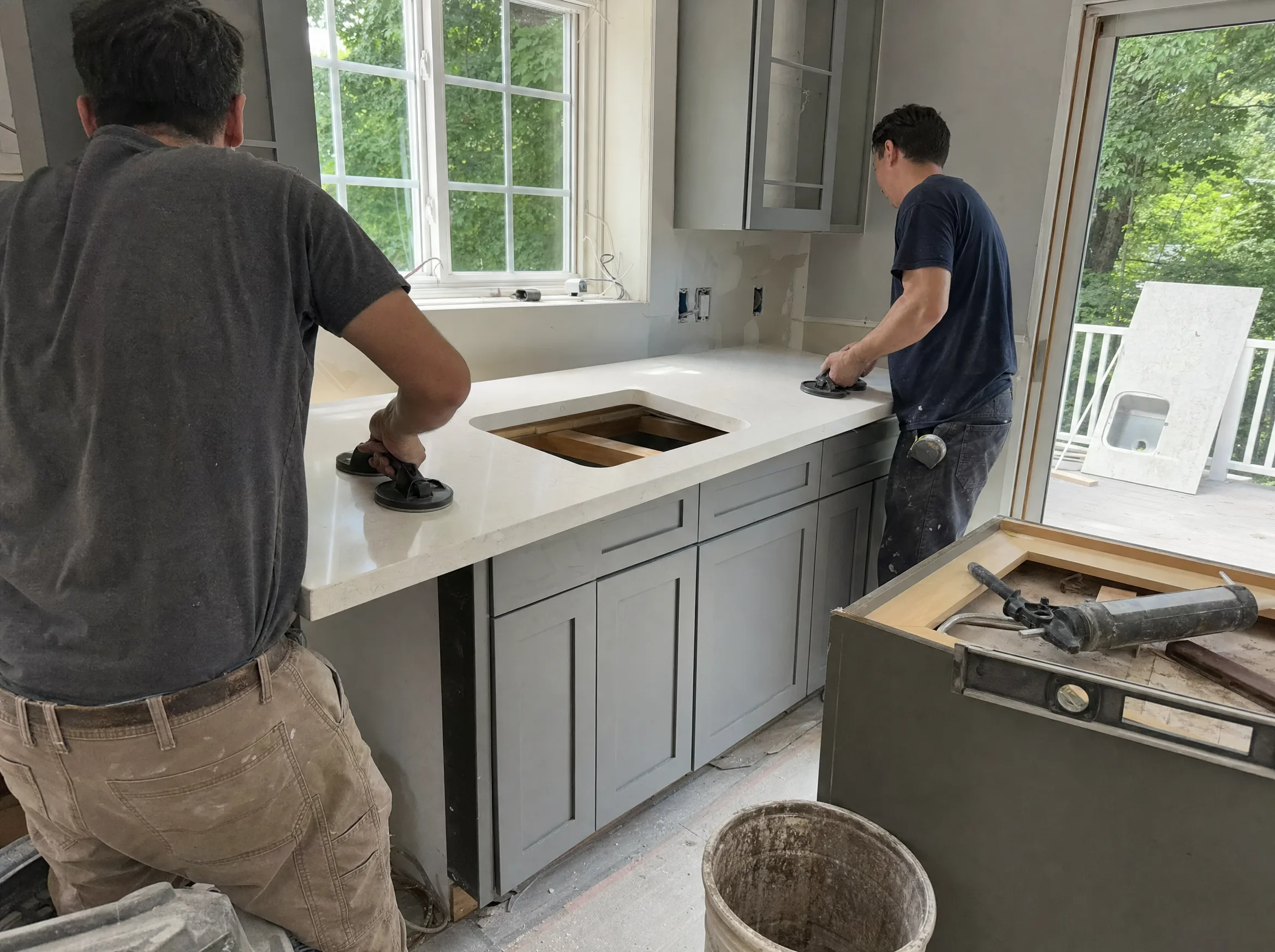
A quartz vanity top is set on the cabinet with beads of 100 percent silicone, the same as other stone tops. A few points specific to quartz:
- The cabinet must be level and flat across its top edges. Stone tops crack when they bridge high spots.
- The backsplash is set in silicone on the top and the wall, then the joints are caulked.
- Cutting or drilling quartz on site makes fine dust that contains crystalline silica. Fabrication is done with water and dust controls; the federal OSHA silica guidance explains why. Plan for the top to arrive cut and drilled, not to cut it in the bathroom.
Care and cleaning
- Daily: warm water, mild dish soap and a soft cloth.
- For residue: a non-abrasive cleaner labeled safe for quartz.
- Avoid: abrasive pads, oven cleaner, paint stripper, nail polish remover left sitting on the surface, and bleach left on for long periods.
- Use a heat-resistant mat or a wall holder for curling irons and flat irons.
What a quartz vanity top costs in Orlando
Installed quartz typically runs $60 to $120 per square foot in the Orlando area in 2026. As arithmetic, a single 37 by 22 inch top is about 5.7 square feet, which works out to roughly $340 to $680 for the stone area alone. In practice the price of a vanity top also depends on:
- Fabricator minimum charges for small pieces
- The sink and the undermount cutout and polishing
- Faucet holes and edge profile
- Thickness (2 cm vs 3 cm) and color
- Removing and disposing of the old top
Labor to set a stone top on an existing vanity is about $250 to $700. These are planning ranges, and a written estimate after measuring is the real number.
Planning a quartz vanity top in Orlando?
Prime Construction measures your vanity and walls, helps you choose a quartz color, edge and sink in a 3D design rendering, and installs the top through our countertop service and bathroom vanity service. If you are in Orange, Seminole, Osceola or Lake County, call (407) 404-3944 or request an estimate.