
Design Ideas
Turquoise Backsplash Tile Ideas for Your Kitchen
Turquoise backsplash tile ideas: subway, glass, zellige-style and patterned tile, the right shade, cabinet and countertop pairings, and Orlando costs.
By the Prime Construction team Updated October 13, 2026 5 min read
A turquoise backsplash works best when the shade is chosen for the room’s light and paired with quiet cabinets and countertops: white, cream or wood cabinets, and a white or soft gray countertop with little veining. The most popular turquoise backsplash tiles are glossy ceramic subway, glass subway and mosaic, handmade-look zellige-style tile, and patterned or Moroccan-style cement-look tile. Below we cover each style, how to pick the shade, what to pair it with, and what to know before installing.
Why turquoise works in a kitchen
Turquoise sits between blue and green, so it reads as fresh rather than cold. It also has a long history in tile, from glazed ceramic to hand-painted patterns, which helps it look intentional rather than trendy.
In Central Florida kitchens with lots of daylight, turquoise reads bright and clean. In a darker kitchen it can go flat or murky, which is why the shade choice matters more than the tile style.
Popular turquoise backsplash tile styles
Turquoise subway tile
The most versatile choice. A glossy ceramic 3x6 or 2x8 subway in turquoise gives you color in a familiar shape. Ways to use it:
- Classic running bond for a cottage or coastal kitchen.
- Vertical stack for a modern look that makes the wall feel taller.
- Herringbone behind the range as a feature panel, with plain subway on the rest of the wall.
Ceramic subway is also the most affordable way to get a turquoise backsplash.
Turquoise glass tile
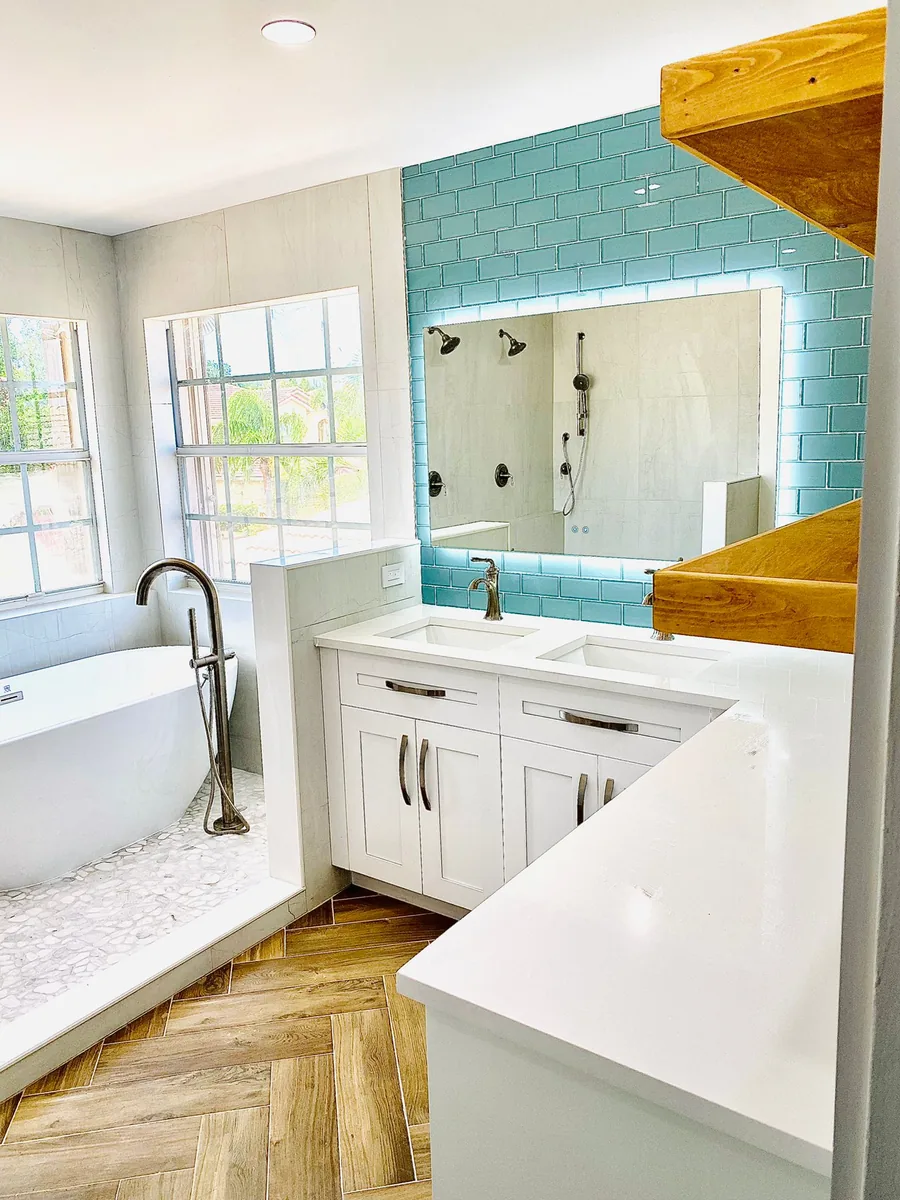
Glass tile reflects light and gives turquoise a deep, watery look. It comes as subway shapes, small mosaics on mesh sheets, and larger glass panels.
What to know before you buy: glass is see-through at the edges and sometimes through the face, so the thinset color and trowel pattern can show. It needs a setting material the glass manufacturer approves (commonly a white thinset), full mortar coverage, and careful cutting. Our glass tile backsplash guide covers the method.
Handmade-look and zellige-style turquoise tile
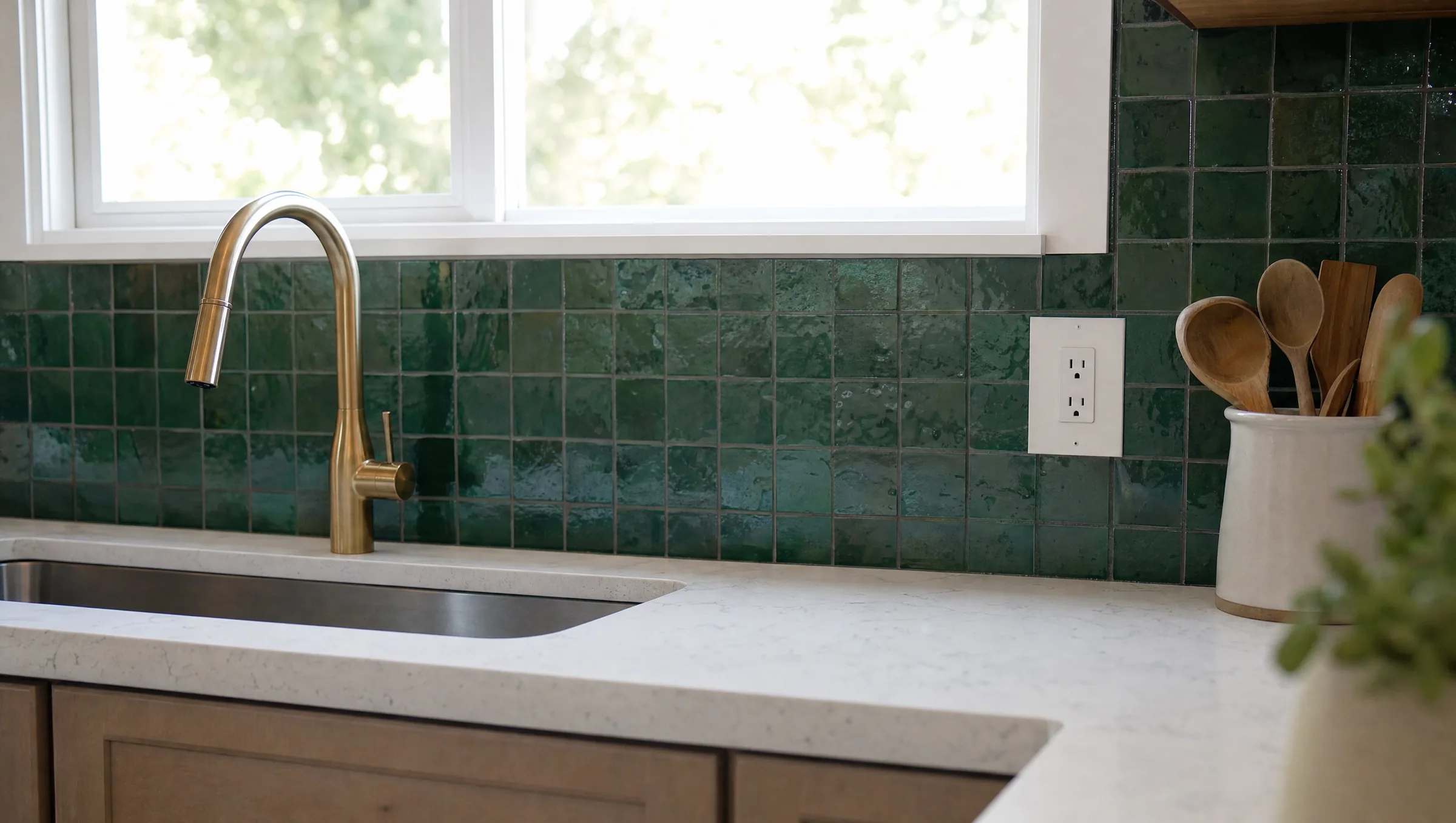
Tile with an uneven glaze that shifts from pale aqua to deep teal across the wall. It is one of the strongest 2026 looks, because the variation keeps a single color from feeling flat. Blend tiles from several boxes as you set them, and keep grout joints tight. Genuine handmade clay tile can be more porous than porcelain, so ask whether it needs sealing.
Patterned, Moroccan and mosaic tile
Turquoise shows up in many patterned tiles, often with white, navy, or warm accents. Options:
- Cement-look or printed porcelain pattern tile with turquoise motifs.
- Arabesque, lantern or star-and-cross mosaics.
- Penny round and small hex mosaics in mixed turquoise shades.
Patterns are strongest in a framed area, such as behind the range or a coffee bar, rather than wrapping the whole kitchen.
Hexagon, chevron and arabesque shapes
Shape adds interest even in a single color. Large hex tiles in matte turquoise look modern; small glossy hex looks vintage. Chevron and arabesque shapes take more cutting at the edges, which adds labor.
Choosing the right shade of turquoise
| Shade | Reads as | Works best with |
|---|---|---|
| Soft aqua, pale robin’s egg | Light, airy, coastal | White cabinets, light wood, bright rooms |
| Classic turquoise | Cheerful, bold | White or cream cabinets, simple countertops |
| Teal and deep peacock | Rich, moody | Wood cabinets, brass hardware, darker counters |
| Gray-green turquoise | Calm, muted | Most cabinet colors; the safest long-term choice |
How to decide:
- Look at samples in your kitchen at morning, afternoon and night. Turquoise shifts a lot under different light.
- Check your light bulbs. Warm bulbs (2700K) push turquoise toward green; cooler bulbs (3500K to 4000K) keep it blue.
- Test large. A single 3x6 tile looks very different from a full wall. Lay out a few square feet of samples on the counter.
Pairing turquoise with cabinets, countertops and hardware
Cabinets
- White or warm white: the classic pairing, bright and clean.
- Natural or medium wood: warm wood balances turquoise and keeps it from feeling cold.
- Cream: softer than white, good with teal and deeper shades.
- Navy lowers with white uppers: a two-tone look that frames turquoise tile well.
Countertops
Let the tile lead. White or off-white quartz with light veining, soft gray quartz, butcher block or a quiet granite all work. Avoid a heavily veined or speckled countertop with a patterned turquoise tile. If you are choosing a new top at the same time, our countertop page explains the options.
Hardware and fixtures
- Brass or gold warms turquoise and suits teal especially well.
- Matte black gives a modern contrast.
- Brushed nickel or stainless stays neutral and coastal.
Design styles that suit turquoise
- Coastal: soft aqua subway, white cabinets, light wood and brushed nickel. A natural fit for Florida homes.
- Mediterranean and Moroccan: patterned tile, warm wood, brass and terracotta accents.
- Mid-century: turquoise with walnut cabinets and simple geometric tile.
- Farmhouse and cottage: turquoise subway with cream cabinets and butcher block.
- Modern: a vertical stack in a single turquoise, flat-panel cabinets, matte black hardware.
If you have a white kitchen and want turquoise as the statement, see our ideas for a white kitchen with a bold backsplash.
What a turquoise backsplash costs
Color does not change the price much; material and pattern do. Typical Orlando-area planning ranges for 2026, installed:
- Ceramic or porcelain subway: low end of about $20 to $60 per square foot.
- Glass, handmade-look and mosaic tile: the high end of that range.
- Most kitchens: about $1,000 to $3,000 total.
Labor goes up with small mosaics, herringbone and chevron layouts, many outlets and windows to cut around, and removing an old backsplash. A written estimate after measuring is the only real number.
Installation and care
- Wall prep: the wall must be flat, clean and sound. Glass and glossy tile show every bump.
- Setting material: use the thinset the tile manufacturer specifies. White thinset is the norm for glass and light tile so gray mortar does not shadow through.
- Grout: unsanded grout for joints under 1/8 inch; sanded for wider joints. Sanded grout can scratch glass, so test on a spare tile.
- Cure time: many cement grouts need 48 to 72 hours before sealing. Check the bag.
- Cleaning: warm water and a mild, pH-neutral cleaner. Skip abrasive pads on glossy and glass tile.
- Grout care: cement grout should be sealed and resealed as the maker recommends. A premixed stain-resistant or epoxy grout cuts down on maintenance.
Planning a turquoise backsplash in Orlando?
If you are in Orange, Seminole, Osceola or Lake County and want to see a turquoise tile with your cabinets and countertop before ordering, Prime Construction offers in-home measuring and 3D design renderings as part of a kitchen remodel. Call (407) 404-3944 or request an estimate.